Sunday 25th April 2010
by duncan on Apr.25, 2010, under Observatory
Ok so I lied, I said I’d be back when the rain stopped but haven’t written an update for 5 weeks.
Where shall I start? The project is still not finished but an end is in sight. After the last post, I built the roof frame and managed to lift the roof into place on my own. I figured if the ancient Egyptians could build pyramids I could lift a roof. I’d be lying (again) if I said it was easy. A steel roof 10′ x 10′ with a wooden frame weighs … well lots, and lifting it into place required me placing wooden rails either side and physically lifting the roof past the tipping point to allow it to fall into place. I stopped for a breather after that!
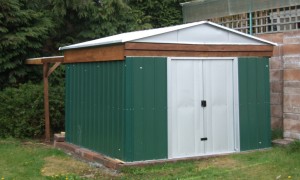
With the roof in place I was able to complete the walls and fascia boards and move onto the rear rail assembly that will support the roof in a “rolled-off” position. Digging 2′ holes for the fence posts was easy enough, trying to hold a post upright and level whilst aligning it with the roof rail (which I couldn’t see) proved to be to too difficult and I eventually built the whole rear assembly upside down on the lawn. After my Herculean efforts with the roof I asked my brother to lend a hand to carry this into place. With a lawn that slopes making everything square and upright was a task. I propped the ends of the main framework on timbers to get it level before fixing the upright fence posts in place. A slight error on my part means one of the posts is not perfectly upright – but close enough. The photo makes it look worse than it is because the steel cladding on the shed runs out slightly where the fascia board pulls the top in. No really – I’m not making excuses.
So where are we – roof in place – rear assembly in place – oh I know what I missed: After getting the roof in place the heavens opened and it rained like I should have built an Ark not an observatory! To my horror the roof leaked. The only reason for buying the steel shed was to make sure the structure was weather proof! Ahhhh. I spent an afternoon with buckets and silicone sealant trying to make running repairs but the silicone washed out but luckily the buckets kept the floor from getting any wetter than it was. The floor wasn’t sealed, it’s made of a type of board that isn’t weather proof and the damp barrier was under it, so when the boards got wet I did worry a little. After several attempts to repair the leaks I got my brother over to help lift the roof off – the once heavy roof was now even heavier as the rails and cross supports where now in place! In hind-sight it was a 4 man job, but by the time we realised that we were past the point of no return. We stripped the roof boards off and re-assembled them, this time with a thick layer of black sticky roof repair goo between each joint and in all the screw holes. On either end we used roofing bolts instead of the provided screws and washers (these are self-tapping bolts with a built in fibre washer). Black goo oozing from the screw holes was dismissed as a necessary evil and the rebuilt structure was manhandled into place, now all I needed was rain to test it.
As luck would have it I didn’t have to wait too long and again AHHHH it leaked! Only in two places, 1 was a screw hole, the other a seam between 2 of the roof sheets. I fixed the screw hole by removing the screw and putting enough black goo over the hole to plug 20 holes, but better safe than sorry. The seam was another issue. The problem was where the sheets overlap. I ran a bead of goo down the whole length of the seam and screwed through from the inside – pulling the two sheets together with goo squeezing out both sides.
So the roof is on, the rear frame in place – no leaks? still waiting for significant rain to test it – on to the wheels and rails. Running castors on a wooden beam will quickly wear a groove, I decided to buy some steel channel for the castors to run in. I decided 4 castors each side would be enough - and if not I’d put some more on. Not exactly a scientific approach – but it worked. So how do you screw castors to a rail that’s upside down and weighed down with a roof. I have these clamps that work by pulling on a trigger to close them and pressing a release button to unclamp. by removing one end of the clamp and putting it on the other end it becomes a spreader! I used these to lift and hold the roof with wooden blocks just in case the roof fell while my arms were under it! The steel was easy to work and I drilled and counter sunk the holes until I broke my counter sink bit, then I used the 20mm bit I’d used on the brake disk as a counter sink – that was fine. Rails in place, wheels in place – paint applied to all exposed steel – now it’s taking shape. Before the wheels and steel rails I was able to haul the roof back a few feet, but now I was able to run it fully off with one hand!
Exterior timber has been painted with wood preserver and the floor covered with wood-oil to waterproof it. I’ve built a wide shelf along the back wall to hold a laptop and any other bits and pieces. I’ve also run an armoured power cable the length of the garden and wired up a consumer unit with RCD and 4 x 13amp power sockets. I have a 6amp circuit for lighting but don’t have a light yet!
So here’s a few photos:
Update 19:05 25-04-2010:
I’m done! I painted the pier and the brake disk, installed a power-line Ethernet adapter to give me network access and fitted a second hasp to the door. I bought 2 padlocks and fitted them as well as some other bits and pieces to help secure the structure.
All that’s left is to find a spanner that will fit under the brake disk to tighten the centre bolt that holds the mount in place. Nothing too serious but without this simple tool I can’t do any more. When done up the bolt is slightly recessed into the brake disk making it difficult to get any type of adjustable spanner (wrench) in there. It’s cloudy tonight so no rush – you can be sure it’ll rain for the next 2 weeks!
Hopefully the next post will be first light at Ty Du Observatory.
Watch this space …
Thursday 18th March 2010
by duncan on Mar.18, 2010, under Observatory
Well things are progressing but more slowly than I’d anticipated. Since the last update I’ve:
- put the shed walls in place
- removed the cardboard column form – to find my attempts at preventing air bubbles had failed
- built an internal wooden framework
- installed the floor and 3 walls
- secured 2 wooden rails inside the shed for the roof to run on
I’ve run two 4″x2″ rails from front to back to support the roof. These rest on 3″x3″ fence posts which are secured in the ground using post supports (metal spikes that are driven into the ground with a box section on top to receive the post). The roof will have corresponding rails and these will be fitted with castors to allow the roof to run easily. At present the rails only run to the back of the shed, these need to be extended outward to support the roof in the “rolled off” position.
I’ve received delivery of timber today to complete the roof by installing an internal 3″x2″ framework onto which two 4″x2″ rails will be run but have been unable to continue with the build due to the weather. It’s been dry since the project began, but there was some fine rain yesterday and “proper” rain today. Hopefully it’ll be dry enough tomorrow to install the roof which can be clamped in place while I complete the inside of the shed. I’ll look into making the roll-off frame either this weekend or if I can’t do it this weekend it’ll have to be next as I’m back in work on Monday.
No photos today, but I’ll do some when the rain stops.
Friday 12th March 2010
by duncan on Mar.12, 2010, under Observatory
More progress:
- Finished laying blocks on concrete as the footer
- Cast the column – that was a big moment
Filling the column form took more concrete than I’d anticipated but I had enough materials to complete it without a trip to the DIY store! A worry of mine was how to compact the concrete within the form to make sure it’s as solid as possible. I used 2 methods. Firstly I used a length of timber to push the concrete down, especially the first couple of shovel fulls, to make sure all the gaps were filled in around the reinforcing rods. Secondly I inserted a right-angled bolt, I think I salvaged it from an old stair gate, into my cordless drill and used the asymmetric motion of the bolt to act as a vibrator to remove air bubbles. I used this against on the framework and also on the top board to effortlessly sink it into the concrete.
All I have to do now is assemble the shed over the column and turn the roof into a roll-off! Easy – I’m not expecting it to be too easy but I’d rather work with a wooden frame than lay concrete blocks!
I bought a bubble level to level the top board and I think that was definitely £1 well spent. Trying to get the column form upright would have been impossible without it. There’s rain forecast today but it should be dry over the next couple of days so hopefully there’ll be an update on Sunday.
more to follow…
Wednesday 10th March 2010
by duncan on Mar.10, 2010, under Observatory
The build is under way!! I’ve been taking it slowly but things are progressing nicely. So far I’ve:
- dug a hole 600×600x600mm
- hammered steel rods into the walls of the hole for stability
- filled the hole with concrete
- inserted steel rods in the centre of the concrete where the column will be cast
- started laying foundation blocks
- started assembling the steel shed
I should be able to cast the column either this evening or in the morning after which I’ll continue with the foundations. I’m only using a single block foundation as there’s no weight in the shed and it’ll be supported internally by a wooden frame.
Here’s a before and after shot showing the location of the observatory:
I can’t believe that since dismantling the mount we’ve had the clearest night skies for months. I just have to console myself with the knowledge that it won’t be long until I can take advantage of any gap in the clouds
More to follow…
Monday 1st March 2010
by duncan on Mar.01, 2010, under Observatory
The observatory build starts next Monday!! Today I’ve found a major flaw in my plan, but I see it as an opportunity to try something different rather than a show stopper. The plan is to fit the flat plate from the top of the tripod into the depression in a brake disk, weld the pieces together and bolt the whole lot to the top of a concrete pillar. I had said I’d build a column form but having looked at my warped timbers I decided to buy a 300mm (outside diameter) x 1 metre tube to cast the column and I found some 10mm brake disks in the bargain bucket at Halfords for £10. I bought M20 threaded bar to sink into the column onto which the disk will fit. Did you spot the flaw? The piece from the top of the tripod is not steel as I expected but is instead a non-ferous alloy of as yet undermined metals. I have an arc welder, my brother has a mig welder but neither of these will weld alloy to steel!
Putting this minor distraction to one side, the column form will be held in place with a wooden cage (I’ve made that) which will sit on wooden beams laid across the base pit. The pit will be approx 900mm cubed with the column rising from the centre. I’ll level the cage by driving timbers into the ground at angles then screwing them to the cage to hold it upright. This will have to be done on the day of the concrete pour to make sure everything is as perfect as I can get it. When the concrete is set I’ll build my self-assembly steel shed around the column. I’ll build a wooden frame inside the shed extending to the rear to allow the roof to be slid off. I’ve found a few examples of this being done online but my favourite, and the one I’m using as inspiration is the Linnhe Observatory in Scotland.
Rather than cast a concrete floor I’ll be laying a waterproof membrane and building a raised wooden floor. The observatory will be for the most part remotely operated so there’s no need to build in creature comforts however I will be including storage for all the astro odds and ends that I’ve collected.
I’ll update this as the project progresses …