Sunday 4th November 2007

I was out on Friday night (the 2nd) and managed to get a few new objects to add to the list. It was fairly clear with wispy high cloud, but as the night went on the dew became an issue with water running down the outside of the scope.

After taking the RA axis apart and reassembling I was keen to see if there was any difference but a hasty polar alignment I think was to blame for the image subject drifting up the screen with a slight zig-zag left to right. I recon if I can learn how to drift align I’ll be a lot closer now to getting longer exposures.

So I pointed the scope westwards, n-star aligned on Vega, Rasalhague and Altair then slewed to M27 for a quick check to make sure the goto was working. It was dead centre so I captured a few images here, then moved on to M57 as usual.
Holmes(17P)

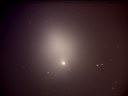
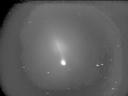
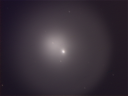
In order to find comet Holmes(17P) I needed to point the scope to the east which meant realigning the mount. This time I had a few problems trying to centre on some brighter stars as eastwards is over the top of my house which makes it difficult to get to the finder because of the angle. I settled on Mirfak, Algol and Almach but only after a lot of “left a bit, right a bit, up a bit ….” you Adjusted Holmes(17P)get the idea, so I was surprised when I told the scope to goto the comet is was just off centre. I have a couple of images like this all taken from the same 100x10sec avi. I’ve been trying to reprocess the image to show some of the internal structure (see left) that others have been able to bring out, but so far there’s not much to see. The comet is so big only the heart of it fits into my feild of view with most of the surrounding gas and very faint tail cropped. Note the stars are elongated as the comet is moving at a different rate to the background.
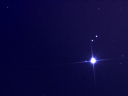
As the scope was pointing eastwards I picked out some clusters that were missing from my messier chart, namely M35, M36, M37 and M38. The problem again is field of view, these clusters are too big for my small CCD. I spent some trying playing with EQMOD Mosaic but couldn’t put the pieces together. I think there was too much drift in each avi which makes the processed images smaller and therefore the edges don’t overlap as they should – if only I’d spent more time doing the polar alignment!!!
atik_k3ccd_0063.pngM1

As the night went on, more objects emerged above the roof, I picked out Atlas and Merope in The Pleiades but couln’t see any nebulosity, I then moved on to a shot of Atik in Perseus before finally getting my first view of M1. I’d tried several times in the past to find M1 visually but with the long exposure set to 40 seconds I managed enough frames to give me my first photo, which as my old school teacher would say, “could do better”. It’s a start, hopefully the next time around I’ll be able to image this supernova remnant with a little more skill than I managed this time, but at least I can fill the space on my messier chart!

Mars had appeared by this time, but everything was soaking from the dew so I decided to pack up and dry everything off. Not a bad night, but I should make better use of the time between good nights to practice, learn and perfect the skills I need when the stars do come out. Next time…
Tuesday 30th October 2007

The sky was clear all day, but I was worried that if I couldn’t get the mount to track I might miss a clear night. I visited a local auto repair shop in my lunch break and bought a tub of general purpose grease. The operating temperatures are -25 to +150 degrees C. Some articles on the subject of (re)greasing the EQ6 recommend special grease with operating temperatures as low as -50 degrees but I was limited by what was available to me.

 I stripped the RA axis whilst cooking our evening meal, so that after eating I could get on with applying the grease. To my surprise when I lifted the lid the grease was very dark in colour and I couldn’t help but laugh at the irony. Most people strip out the black (marmite) grease that used to come packed into the EQ6 gears and replace it with nice white synthetic grease, but I was replacing the white with the black.

Anyway, the point is whatever grease you use there should be enough to pack the bearing and tapered bearings at the base of the RA shaft were nearly grease free.

I stripped the shaft down as far as the worm and cleaned and regreased this, I then reassembled the mount and packed the tapered bearing before carefully inserting it back onto the RA shaft without getting black slime over everything. The operation complete I tightened the retaining bolt and the locking grubs.

Now for the fine tuning. I left the allen bolts finger tight on the worm housing and powered the mount. Performing a slew from left to right at speed 8 was accomplished without any unwanted grinding sounds so I slowed the mount down to 5 and tried again. It took a while before I realized the mount was moving – it’s very quiet now! I carefully tightened the allen bolts that hold the worm casing in place and tightened the small grub screws until they touched the internal stops. I didn’t want to apply any unnecessary pressure to the worm.

With the mount slewing I applied more pressure to the allen bolts until all were tight without. Next step – test it!

Imagine my disappointment when I finally carried the mount to the garden to find a number of large clouds rolling overhead. But I’m not easily put off and set everything up as there were gaps in the clouds so at least I’d get a chance to have another look at the comet.

I n-star aligned on mirfak, almach and algol which are all in the vicinity of comet Holmes(17P). I was trying not to slew the mount too far incase there was too much play in the RA axis. A goto on the comet put it just off centre and I started imaging my first sequence while I went indoors to take the controls remotely from a warm room.

holmes17p_k3ccd_0047a.pngholmes17p_k3ccd_0048a.pngholmes17p_k3ccd_0049.png

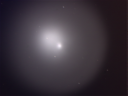
The first and third images are stacked from 12 second exposures, the middle image is a stack of 2 second exposures to allow me to compare it with yesterdays results. No greenish hue visible today, infact I’d say more red if anything. The images have been stacked in registax with darkframe extraction but no post processing has been done on these.

I think my results are improved over yesterdays as I stacked the images by selecting a faint star rather than the comet as my alignment point.

I’ve just returned from realigning the scope in a westerly direction, Vega, Altair and Daneb as my 3 star alignment by the clouds seem to be getting worse. I want to see if there’s any improvement in the tracking now that the RA axis is properly lubed, but I may have to wait for another clear night before I have a chance to test this properly.

Monday 29th October 2007

I stripped down the RA axis on the EQ-6 to see if there was anything obvious stuck in the worm gear as I’d read reports of some being filled with sticky black grease and metal shavings from the inside of the casting.

 I was pleasantly surprised to find clean white grease in my mount and after examining the worm and RA gear I was unable to find any swarf or other debris lodged in it.

A good site for instructions on how to take the mount apart is: http://www.jamesrobertcook.co.uk/RA_axis.htm the instructions are clear and each step has a photo to help you identify the correct parts.

 What these sites don’t tell you is how to put it back together again! Ok I can get all the parts in the right place, but the gear mesh is adjustable with grub screws and I’m having a little trouble getting the gears meshed without play in the axis.

I couldn’t wait until I’d fixed it though as there was a small gap in the clouds, so I had to take the opportunity to see if I could find the comet everyone is talking about – Holmes(17P). This comet suddenly changed in brightness from magnitude 17 to magnitude 2.5 in a matter of hours and is clearly visible to the naked eye just below and to the north of Mirfak.

I started by trying a one star alignment with EQMOD and when I looked through the finder the comet was there in the middle. I started imaging straight away before the clouds came back and managed 2 avi’s with 50+ frames in each.

holmes17p_k3ccd_0045.jpgholmes17p_k3ccd_0046.png

They’re very simillar shots but the second one shows more green colour which been reported by others. The comet fills the field of view in my SPC900NC and to think I was going to get the 2x barlow out for this.

The images were both 2 second exposures with frames stacked and wavelets in Registax and finished off in Photoshop.

Friday 12th October 2007

I haven’t been out for a while so not able to continue smoothing my learning curve with the EQMOD. But when you can’t get out to play, why not spend the time learning new techniques and catching up on the forum chat.

It was while I was reading through the forums that I found this link from Sander Pool on the Yahoo Autoguiding site: http://www.ewellobservatory.com/bestpractices/player.html

Make sure you have a spare 45 minutes before clicking the link, I found it very informative and even though the target audience are experienced astronomers, there’s a lot of very useful information here for us amateurs as well.  In the presentation there’s a reference to FocusMAX and CCDInspector, both of which are available here: http://www.ccdware.com/downloads/. I don’t have an auto-focuser (yet) so haven’t downloaded FocusMAX but I’ll have a look at CCDInspector if it can help me collimate my scope.